
Local SEO optimization means making your business easier to find and trust in local Google Search and Maps. Start by optimizing your Google Business Profile, targeting relevant local searches, improving your website, earning genuine reviews, keeping business information accurate, and building relevant local authority. In my view, consistency matters most: keep your information useful, accurate, and genuinely helpful to customers.
Local SEO Optimization: Start With What Customers Actually Search
The local SEO optimization tips below will help you achieve higher rankings in local searches. The critical point is to switch the focus from the marketer’s perspective to consumer’s one.
In other words, you should think about what terms the customers are likely to use in their queries.
For example, such phrases may include “dentist near me,” “SEO agency in Indore,” or “AC repair in Gwalior.” Another helpful technique is to write down five questions a client may ask before calling your company and ensure that the answers are available on your Google Business Profile and website.

Local Search Optimization Is About Trust, Not Just Visibility
Attracting nearby clients is only half of the deal. To build a long-lasting relationship with your audience, you need to learn how to retain them. One way to do that is to make your business appear in Google searches more often. However, it is not enough to get your profile in front of a customer; you need to encourage him or her to visit your page again and share positive feedback about your services.
Adding relevant information to your Google Business Profile, reviews, services description, contact details, and images may considerably improve your chances of being recognized and recommended by local customers. For instance, when in need of a plumber, a person will more likely choose a company that has all the necessary data filled in, up-to-date reviews, organized service catalog, and contact information, along with recent photos.
Step-by-Step Local SEO Optimization
1. Define Your Local Search Goals
Don’t start by creating dozens of location keywords.
Start with the business.
Ask:
- What products or services generate the most value?
- Which locations do we genuinely serve?
- Which searches would indicate strong customer intent?
- Do customers come to us, or do we go to them?
- Do we want phone calls, inquiries, bookings, visits, or online purchases?
For example, a local dentist may be more interested in dental treatments and appointments, whereas a home-service plumber may be focused on urgent searches and a specific service area.
This has implications for your Google Business Profile, website, content, and measurement.
2. Claim and Verify Your Google Business Profile
For an eligible local business, Google Business Profile is one of the most important parts of the local-search foundation.
A verified Business Profile allows customers to find business information across Google Search and Maps. Google provides Business Profiles at no charge for eligible businesses.
Start by:
- Searching for your business on Google.
- Checking whether a profile already exists.
- Claiming it if appropriate.
- Completing Google’s verification process.
- Reviewing the information displayed publicly.
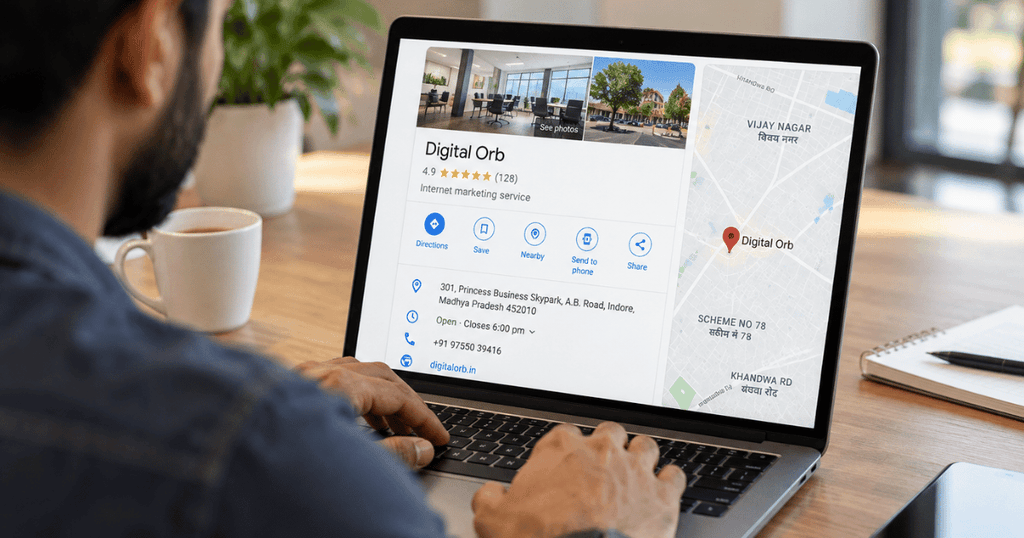
Do not create multiple profiles simply because you want to target multiple neighbourhoods or cities.
Your profile should represent a real eligible business and accurately reflect where and how you operate.
3. Complete and Optimize Your Business Profile
Once your profile is verified, review every relevant field.
Pay particular attention to:
- Business name
- Primary category
- Additional categories where genuinely applicable
- Address
- Service area
- Phone number
- Website
- Business hours
- Special hours
- Services
- Attributes
- Photos and videos
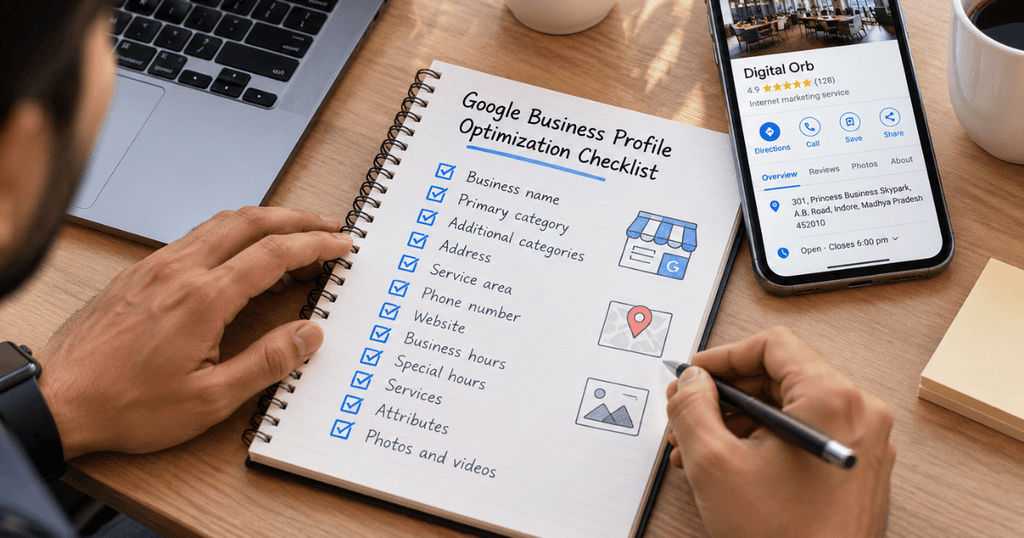
Accuracy in local SEO optimization matters more than inserting keywords everywhere.
For example, don’t rename your business from:
Digital Orb
to something like:
Digital Orb – Best Local SEO & Digital Marketing Company in Indore
unless that is genuinely the business’s real-world name.
Google’s Business Profile guidance specifically says categories should not be used simply as keywords or to describe features.
The same principle applies to your business description and other profile information: describe the business clearly rather than trying to manipulate the system.
4. Set Your Service Area Correctly

This is particularly important for Indian service businesses that don’t operate from a customer-facing storefront.
Google distinguishes between storefront, service-area, and hybrid businesses.
A service-area business generally travels to or delivers to customers rather than serving them at its business address. A hybrid business can serve customers at its location and also travel to customers.
If your business operates as a service-area business:
- Don’t create fake offices in different cities.
- Don’t use virtual locations as substitutes for genuine business locations.
- Specify the areas you actually serve.
- Keep your profile aligned with Google’s eligibility and representation guidelines.
Google currently allows service areas to be specified using cities, postal codes, or other defined areas rather than an adjustable radius.
This matters in India because a business may serve an entire city or several nearby areas without having a physical storefront in every location.
5. Research Local Keywords Based on Customer Intent
Keyword research still matters, but local SEO optimization shouldn’t become just a list of city names.
Start with your core service.
For example:
Core service: Digital marketing agency
Potential local searches could include:
- digital marketing agency in Indore
- digital marketing company near me
- SEO agency in Indore
- local SEO services in Indore
- Google Ads agency in Indore

Then separate keywords by intent.
| Intent | Example |
|---|---|
| Informational | how does local SEO work |
| Commercial research | best local SEO services |
| Local commercial | local SEO agency in Indore |
| High intent | local SEO services near me |
| Navigational | Digital Orb Indore |
The goal isn’t to use every variation on one page.
Instead, map different search intents to the most appropriate pages.
A service page might target a service-focused commercial query, while a blog can answer an informational question.
6. Optimize Your Website for Local Search
Your website should make it immediately clear:
Who you are, what you offer, and where you serve.
Start with the basics.
Your homepage
Clearly communicate your primary service and target market where appropriate.
Service pages
Create useful pages for important services rather than putting everything into one generic page.
For example:
- SEO services
- Local SEO
- Website development
- Google Ads
- Social media marketing
Each page should explain the service, who it is for, what the process involves, and what the customer should consider.
Contact page
Make your contact information easy to find.
Depending on the business, this could include:
- Phone number
- Address
- Business hours
- Service area
- Directions
- Contact form
Internal links
Connect related pages naturally.
For example, an article explaining local SEO for small businesses can link to your dedicated local SEO service page when the reader needs more information about professional implementation.
Don’t create links simply to increase the number of internal links. Each link should help the reader move to a useful next step.

7. Create Location Pages Only When They Provide Real Value
Location pages can be useful when a business genuinely serves multiple locations.
But there is an important distinction between useful local pages and pages created only to capture search variations.
Suppose a company genuinely has offices in Indore, Bhopal, and Jaipur.
Separate location pages may make sense if each page contains meaningful information about that location.
But creating 50 nearly identical pages such as:
- Digital Marketing Agency in Area A
- Digital Marketing Agency in Area B
- Digital Marketing Agency in Area C
with only the location name changed provides little value.
Google’s spam policies specifically identify pages targeting multiple regions or cities that funnel users toward one destination as an example of doorway abuse.
A useful location page should answer questions such as:
- Where do you operate?
- What services are available there?
- What type of customers do you serve?
- How can customers contact you?
- What is genuinely different or useful about this location?
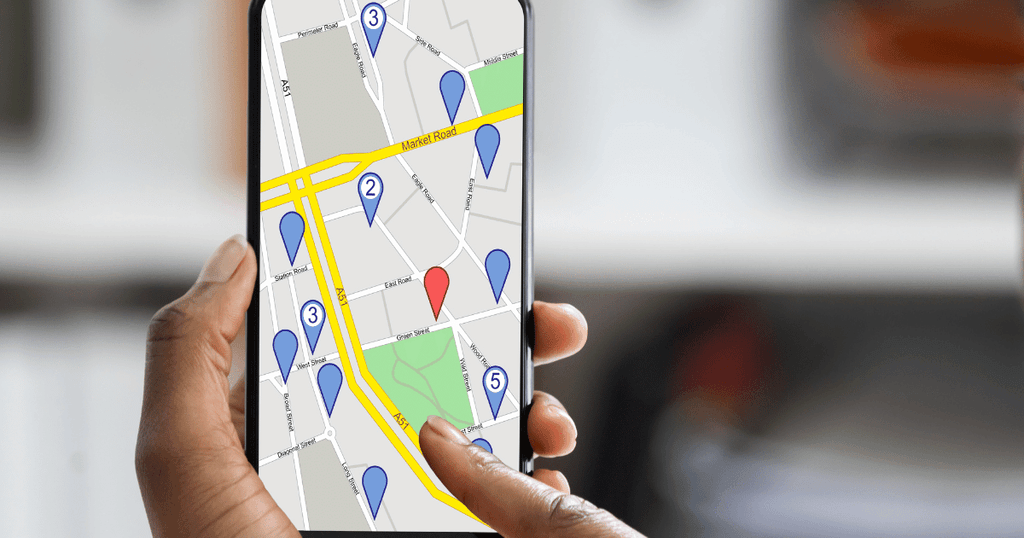
If you don’t have enough useful information to make a location page meaningfully different, you may not need one.
8. Build Trust With Genuine Customer Reviews
Reviews matter for both customers and local visibility.
Google recommends responding to customer reviews and says positive reviews and helpful replies can help a business stand out. Google also identifies reviews as one source of information contributing to local prominence.
A sustainable review process is simple:
- Provide a good customer experience.
- Ask appropriate customers for honest feedback.
- Give them a convenient way to leave a review.
- Respond professionally.
- Address legitimate complaints.
- Never manufacture reviews.

Avoid offering incentives in exchange for positive reviews or asking customers to write specific wording.
The purpose of reviews should be to collect genuine customer feedback, not manufacture a particular ranking signal.
A thoughtful response to a negative review can also demonstrate that the business takes customer concerns seriously.
9. Keep Business Information Consistent
Your business information should be accurate wherever customers might encounter it.
Check:
- Business name
- Address
- Phone number
- Website
- Hours
- Business description
- Service information
Review important third-party listings periodically, especially after a business changes its address, phone number, branding, or operating model.
However, local citation building should not become a numbers game.
You don’t need to submit your business to every directory you can find.
Prioritize legitimate, relevant platforms that customers actually use or that meaningfully represent your business.
In local SEO optimization, accuracy and relevance are more valuable than collecting hundreds of low-quality listings.
10. Earn Relevant Local Links and Mentions
Links can contribute to a business’s prominence, according to Google’s local-ranking guidance.
For a small business, relevant local links might come from:
- Local business organizations
- Industry associations
- Community organizations
- Local publications
- Genuine partnerships
- Relevant local events
- Suppliers or professional networks
- Industry-specific resources

The important word is relevant.
Don’t buy hundreds of unrelated backlinks because someone promises faster local rankings.
A useful local mention should make sense even if Google didn’t exist.
Ask:
Would this link still be valuable because it puts my business in front of a relevant audience?
If the answer is yes, it is more likely to be worth pursuing.
11. Publish Content That Helps Local Customers
Local content shouldn’t mean adding a city name to every paragraph.
Instead, create content around questions your local customers actually have.
For example, a dental clinic could publish:
- How often should you get a dental check-up?
- What should you ask before choosing a dental clinic?
- What happens during a root canal consultation?
A digital marketing agency could publish:
- How local SEO works for small businesses
- How to optimize Google Business Profile
- Local SEO mistakes businesses should avoid
- How to measure local search performance
Then add local context only where it genuinely improves the answer.
For Indian businesses, this can also mean addressing the practical realities of serving particular cities, neighbourhoods, customer segments, or service areas.
The objective is not to publish hundreds of local articles.
Google’s current guidance emphasizes helpful, reliable, people-first content and specifically warns against creating content primarily to manipulate search rankings.
12. Use Local Business Structured Data Where Appropriate
Structured data can help Google understand important information about a business and its pages.
Google’s LocalBusiness documentation explains that this structured data can communicate information such as business hours and other business details. Google recommends following its structured-data guidelines and validating implementation before deployment.
Depending on your business and website, relevant information may include:
- Business name
- Address
- Phone
- Website
- Opening hours
- Business type
- Location information
But structured data is not a magic ranking button.
Adding schema does not guarantee higher rankings or a particular search appearance.
Think of it as a way of communicating structured information more clearly, while the visible page content still needs to be accurate and useful.
13. Make the Website Easy to Use on Mobile
Local searches frequently lead to immediate actions.
A customer may want to:
- Call
- Get directions
- Check hours
- Compare services
- Send an enquiry
- Book an appointment
- Visit the website
That means your website shouldn’t force users to hunt for basic information.
Check your mobile experience:
- Is the phone number easy to tap?
- Is the contact form usable?
- Can visitors quickly understand what you offer?
- Are important pages easy to navigate?
- Does the page load efficiently?
- Is the text readable?
- Are buttons large enough to use comfortably?
Local SEO brings visibility. Your website experience helps determine what happens after someone arrives.
14. Measure Local SEO Performance
Don’t judge local SEO solely by whether you rank for one keyword.
Local rankings can vary depending on the searcher’s location and query, so a broader measurement system is more useful.
Google Business Profile Performance can provide information about how customers discover and interact with a profile, including searches, views, calls, directions, website clicks, messages, and other applicable metrics.
You can monitor:
Google Business Profile
- Profile views
- Search queries
- Calls
- Website clicks
- Direction requests
- Other available interactions
Google Search Console
- Impressions
- Clicks
- Queries
- Pages receiving organic traffic
- Indexing issues
Website analytics
- Local organic traffic
- Contact-form submissions
- Phone enquiries
- Bookings
- Lead quality
- Conversion rates
Business outcomes
Ultimately, ask:
Are more relevant local customers discovering and contacting the business?
A ranking improvement that produces no meaningful business activity deserves closer investigation.
Local SEO Optimization for Businesses in India
Local SEO in India needs to reflect how the individual business actually operates.
A storefront business, a home-service provider, and a professional service company may require different approaches.
Storefront businesses
Examples include:
- Restaurants
- Retail shops
- Salons
- Clinics
- Gyms
Focus on accurate location information, opening hours, categories, reviews, photos, services/products where applicable, and a useful website.
Service-area businesses
Examples include:
- Plumbers
- Electricians
- Home cleaning businesses
- Repair services
- Some professional service businesses
The important distinction is that the business should only identify areas it genuinely serves. Google provides specific guidance for service-area businesses and says they should use one profile for the central office/location rather than creating separate profiles for every service area.
Multi-location businesses
If a business genuinely has multiple eligible locations, each location needs accurate representation.
Don’t create artificial locations simply to capture additional searches.
Common Local SEO Mistakes to Avoid
Keyword stuffing
Adding phrases such as “best dentist in Delhi” repeatedly doesn’t make a page more useful.
Write for the customer first.
Fake business locations
Don’t create fake offices or virtual locations simply to appear closer to searchers.
Fake reviews
Fake reviews can damage trust and create policy problems.
Creating hundreds of similar city pages
If every page contains essentially the same content with a different city name, you’re not building a useful local resource.
Ignoring your website
A Business Profile and a website work together. Your website should clearly explain your services and provide a useful destination for people who want more information.
Focusing only on rankings
Rankings are useful, but calls, enquiries, visits, bookings, and qualified leads are closer to the actual business objective.
Assuming local SEO is a one-time task
Businesses change.
Hours change. Services change. Locations change. Customer questions change.
Local SEO should therefore be treated as an ongoing optimization process rather than a one-time setup.
A Practical Local SEO Optimization Checklist
Use this checklist when auditing a local business.
Google Business Profile
- Business claimed and verified
- Correct business name
- Appropriate primary category
- Relevant additional categories
- Accurate address or service area
- Correct phone number
- Website connected
- Current business hours
- Services completed
- Relevant attributes completed
- Quality business photos
- Reviews monitored and answered
Website
- Clear service information
- Relevant local intent addressed
- Contact information easy to find
- Important service pages created
- Useful internal links
- Mobile-friendly experience
- Fast and usable pages
- Appropriate structured data
- No unnecessary duplicate location pages
Authority
- Important business listings are accurate
- Relevant local citations maintained
- Genuine local mentions pursued
- Relevant industry links developed
- Customer reviews requested appropriately
Measurement
- Google Search Console configured
- Business Profile Performance monitored
- Website conversions tracked
- Calls/enquiries measured
- Search queries reviewed
- Local visibility reviewed periodically
When Should You Consider Professional Local SEO Help?
You don’t necessarily need an agency for every local SEO task.
A small business can handle many basics internally, particularly if it has one location and someone available to manage its online presence.
Professional help becomes more useful when:
- You operate multiple locations.
- Your website has technical SEO problems.
- You serve several cities or service areas.
- Competitors have stronger local visibility.
- You need structured keyword and content planning.
- Your Business Profile has persistent issues.
- You need local link-building or reputation-management support.
- You want to connect SEO activity with lead generation.
- You don’t have the time or expertise to manage the process consistently.
Ask what it will actually do.
A good local SEO process should specifically explain what it’s going to do, how, how it’ll measure and report, its limitations, and what business information you’re responsible for providing.
Don’t fall for people who promise to get you a certain rank on Google. Google even says that no one can pay them to get a better local ranking.
Conclusion
The success of local SEO optimization is not based on some secret method to improve rankings, but rather on making the business easy to understand, trust, find and contact.
Start with the fundamentals:
- Establish accurate business information.
- Claim and verify your Google Business Profile.
- Choose relevant categories and services.
- Define the locations you genuinely serve.
- Research local search intent.
- Improve your website and important service pages.
- Earn genuine reviews and respond to them.
- Maintain relevant business listings.
- Build useful local authority.
- Create content that answers the questions of potential customers.
- Use structured data when appropriate.
- Measure visibility and business impact.
The most successful local SEO strategies are not the ones that use the most keywords or have the most location pages but rather provide accurate information to consumers and enough information for search engines to accurately interpret the business.
For companies looking to improve their local search presence and don’t have the time or expertise to do it internally, Digital Orb can help with local SEO, website optimization, content, and beyond with digital marketing.
FAQ
Q. What is local SEO optimization?
Local SEO optimization is the process of improving a business’s online presence in order to make it more easily discovered for relevant searches associated with a particular geographical location. It comprises Google Business Profile, website optimization, reviews, local content, relevant citations, links, and other local signals.
Q. How do I optimize my business for local SEO?
Claim and verify your Google Business Profile, making sure that your business information is accurate, selecting appropriate categories, defining your genuine service area, optimizing your website, soliciting authentic reviews, building relevant local authorities, and measuring performance.
Q. Does Google Business Profile improve local SEO?
A complete and correct Google Business Profile helps Google understand your business and improves your chances of being discovered by customers in Search and Maps. Google considers relevance, distance, and prominence as the key factors for local ranking.
Q. How important are Google reviews for local SEO?
Reviews are important for driving customer opinion and local visibility. Google says that reviews contribute to prominence, and that more reviews and positive ratings can boost local rankings.
Q. Should I create a separate page for every city I serve?
Not automatically. Create separate location pages when they provide genuinely useful, location-specific information. Creating large numbers of substantially similar pages in order to target different locations is a bad user experience and Google’s doorway-abuse guidance.
Q. How long does local SEO take?
There is no guaranteed timeframe, as many factors can influence the rate at which your business appears in local searches, including your business’s starting visibility, competition, location, website quality, authority, the condition of your Business Profile, and the searches you’re targeting. Avoid providers who guarantee a specific ranking or result.