
Ecommerce SEO Optimization refers to the methods that can be implemented to make a business website easy to understand by Google and increase its sales through improved customer experience. According to my personal experience, the main ways of optimizing an online store are related to targeting the key areas, such as keywords, products, and categories, technical structure, internal linking, buying-related content, and backlinks. It is critical to optimize the offers based on their priority, monitor the outcomes, and continue the progress.
Ecommerce SEO Optimization: Focus on Buyers, Not Just Rankings
Here’s the thing: getting an ecommerce page onto Google is only half the job. The most important thing is to get somebody interested to buy. People sometimes try to chase down keywords that have a lot of traffic. But it does little if they’re not interested in purchasing.
So we can find what people search about before buying and create landing pages around their search terms. Instead of using broad, best-selling keywords like ‘shoes,’ an online store would narrow the niche to something like “running shoes for flat feet” or ‘running shoes men under ₹5,000.’ There may be less search volume, but users are more qualified and know what they are looking for.
Ecommerce SEO Strategy: Improve the Pages That Already Matter
In many cases, improving organic traffic does not require creating more content. Sometimes it is best to look at the current page or product category.
Once there was an online store with a problem: the best-selling goods had a decent amount of traffic, but no description or internal connections. Instead of creating new blog posts, it seemed like a better idea to optimize the existing page. By improving the most important pages, increasing the relevance and helpfulness of the existing pages for the user,
it becomes possible to raise the rating of the entire store. The first step should be to improve the top 10 or 20 pages in terms of revenue and work on them before moving on to the rest of the website.
Ecommerce SEO Optimization: 10 Strategies That Work
1. Start With the Keywords Your Customers Actually Use
Let’s start with keyword research.
Not because it’s the most exciting part of SEO—it definitely isn’t—but because getting this wrong can send everything else in the wrong direction.
A common mistake is choosing a huge keyword because it has lots of searches.
For example, if you sell running shoes, you might be tempted to target:
“running shoes”
Fair enough.
But what if a smaller business focused on something more specific, such as:
- Best running shoes for beginners
- Running shoes for flat feet
- Men’s running shoes under ₹5,000
- Lightweight running shoes for daily use
- Buy trail running shoes online

Those searches tell you much more about the person behind the search.
That’s what makes search intent so important.
Someone searching “running shoes” could be researching, browsing, comparing or shopping.
Someone searching “buy men’s running shoes under ₹5,000” is giving you a much clearer signal.
I usually divide ecommerce keywords into four broad groups
| Type | Example | Best Page |
|---|---|---|
| Informational | How to choose running shoes | Blog |
| Commercial | Best running shoes for beginners | Guide/category |
| Transactional | Buy men’s running shoes | Category |
| Product-specific | Nike Pegasus 41 price | Product |
You don’t have to do anything fancy-sounding.
Just open Google keyword planner, Google search, search console, or whatever SEO tool you want to use.
Start finding the phrases your customers are using
Then ask yourself one simple question:
“Which page on my site would best answer this phrase if someone searched for it”
If you can’t come up with an answer, maybe you shouldn’t make the page after all.
2. Don’t Ignore Your Category Pages
Here’s an ecommerce SEO problem I come across quite often.
The business has 500 products, but the category pages are practically empty.
There’s a heading.
A product grid.
Maybe a banner.
That’s it.
Category pages can be much more useful than that.
Suppose you sell skincare products.
Instead of having a generic category called:
Face Care
you might have categories such as:
- Face Serums
- Vitamin C Serums
- Moisturizers for Dry Skin
- Sunscreen for Oily Skin
- Natural Face Masks

Each category gives you an opportunity to target a more specific search.
A well-planned Ecommerce SEO Optimization approach also makes sure these categories match what shoppers are actually searching for.
But don’t write 1,000 words of filler just because someone told you that “long content ranks.”
That’s not the point.
Give shoppers enough useful information to understand what they’re looking at.
You might briefly explain:
- What products are included
- Who they’re suitable for
- What makes them different
- How customers can choose between them
Then let the products do the rest.
A good category page should feel like a useful shopping shelf—not an SEO essay.
That’s a small distinction, but it makes a big difference.
3. Make Your Product Pages More Useful
Your product page is probably one of the most important pages on the entire website.
It’s also where many ecommerce stores become lazy.
I’ve seen product descriptions that are basically:
“Premium quality. Best material. Buy now.”
That’s not enough information for a customer, and it doesn’t give search engines much context either.
Think about the questions a real buyer would ask before purchasing.
If you’re selling a backpack, they might want to know:
- What material is it made from?
- What laptop size does it fit?
- How much does it weigh?
- Is it waterproof?
- How many compartments does it have?
- What’s the warranty?
- How does it fit?
- How long does delivery take?

Answer those questions on the page.
Here’s a simple example
Instead of:
Premium cotton shirt for men.
you could say:
Made from lightweight cotton, this regular-fit shirt is designed for everyday wear. The breathable fabric makes it particularly comfortable in warmer weather, while the machine-washable finish makes it easy to maintain.
Notice what’s happening here.
We’re not stuffing keywords into every sentence.
We’re simply explaining the product properly.
That’s better SEO because it’s better information.
Good Ecommerce SEO Optimization follows the same principle: make the page genuinely useful before worrying about how many times a keyword appears.
And don’t copy the manufacturer’s description
If 100 other websites are selling exactly the same product and all of them have copied the same description, yours isn’t particularly distinctive.
Write it in your own words.
Add details your customers actually care about.
If you have genuine customer questions, include those too.
4. Keep Your Website Structure Simple
Ecommerce websites have a habit of growing into a mess.
You start with 20 products.
Then 50.
Then 200.
Then someone adds tags, filters, collections, color variations and sorting parameters.
Suddenly, your website has thousands of URLs.
This can create unnecessary crawling and indexing problems.
A relatively simple structure is usually easier to manage:
Homepage → Category → Subcategory → Product
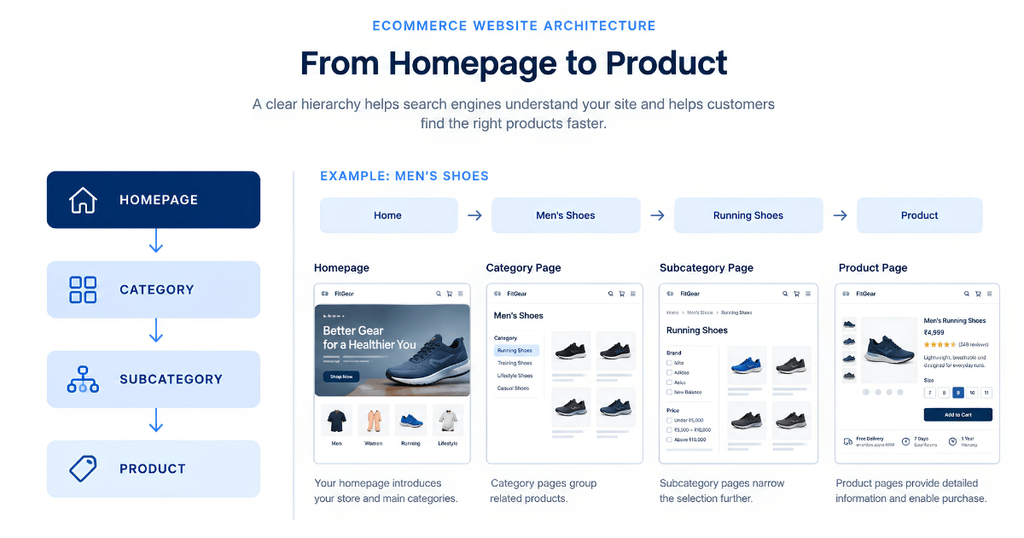
For example:
Home → Men’s Shoes → Running Shoes → Product
The exact structure will depend on your store, of course. But the basic idea is to make the important pages easy to reach.
That’s an important part of Ecommerce SEO Optimization because search engines and shoppers both need a clear path through the store.
Your URLs should also be understandable.
For example:
example.com/mens-running-shoes
is much easier to understand than:
example.com/product?id=82731
You don’t need to make URLs clever.
Just make them clear.
One warning: don’t keep changing them
I’ve seen businesses redesign their websites and change hundreds of URLs at once.
Then organic traffic drops.
If a URL genuinely needs to change, handle the old URL properly with an appropriate redirect. Don’t just assume Google will figure everything out.
5. Use Internal Links Like You Mean It
Internal linking sounds boring.
It’s also one of the easiest things to neglect.
But think about how a customer actually shops.
They might read an article about choosing running shoes.
From there, they want to see running shoes.
From the running shoe category, they might look at a particular product.
Then perhaps they discover running socks or insoles.
Your internal links can help create that journey.
For example:
Blog post → Running Shoes Category → Product → Related Product
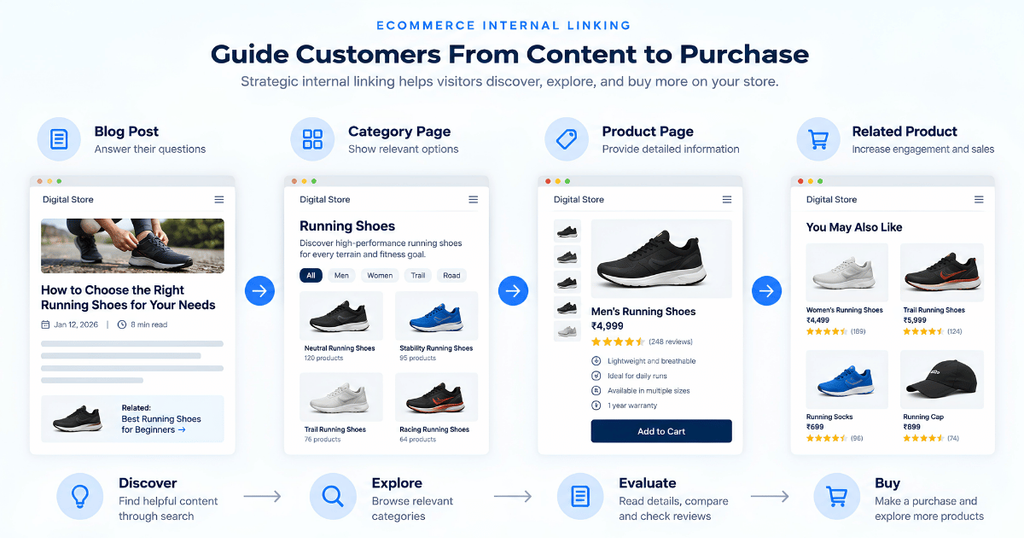
This helps shoppers move around your website without having to go back to Google every time.
It also helps search engines understand the relationship between pages.
Here’s a practical way to start
Look at your 10 most important pages.
For each one, ask:
“Which other page should a visitor see next?”
Then add a natural internal link.
Don’t force it.
If you’re writing about choosing a laptop for graphic design, linking naturally to your laptop category makes sense.
Adding five unrelated links just because you want to “increase internal linking” doesn’t.
Internal linking is only one part of a larger SEO strategy.
For a broader approach covering technical SEO, content, keywords, and authority building, explore our SEO services in Indore.
6. Make Your Ecommerce Website Fast
This one is easy to understand from a customer’s perspective.
If your website takes forever to load, people leave.
You don’t need to be an SEO expert to understand that.
Ecommerce websites can become particularly heavy because they often contain:
- Large product images
- Tracking scripts
- Chat widgets
- Reviews
- Payment tools
- Pop-ups
- Filters
- Analytics
- Marketing plugins
Each one might seem harmless.
Together, they can make a page painfully slow.

Start with the obvious stuff
Compress your product images.
Don’t upload a huge original photograph if the website only needs a smaller version.
Review unnecessary plugins and scripts.
Check your mobile experience.
And test your important pages rather than just testing the homepage.
I’d check at least:
- Homepage
- Main category
- Important subcategory
- Best-selling product
- A typical product page
Google’s Core Web Vitals can also help you identify specific performance problems.
The goal isn’t to chase a perfect score just for the sake of seeing a green number.
Ecommerce SEO Optimization isn’t about chasing technical scores for their own sake. The real goal is to make the store fast, stable and easy to use.
The goal is a website that feels quick and stable when a real person uses it.
7. Give Google Better Product Information With Structured Data
Have you ever searched for a product and seen a result showing a rating, price and availability directly in Google?
That information can be generated using structured data.
For ecommerce websites, product structured data can help search engines understand details such as:
- Product name
- Brand
- Price
- Availability
- Reviews
- Ratings
- Product identifiers
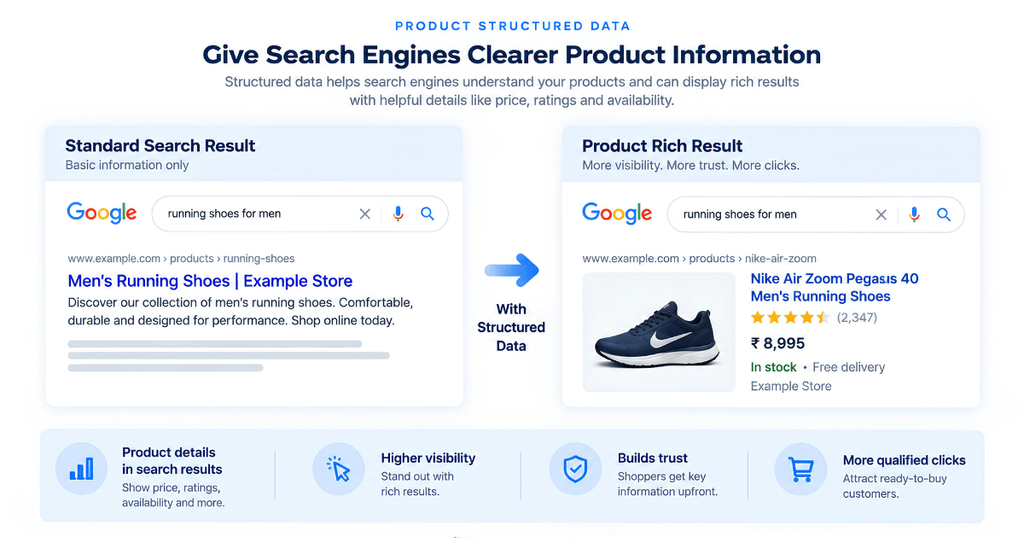
It doesn’t mean your page will automatically rank number one.
It doesn’t even guarantee enhanced search features.
But when implemented correctly, it gives search engines clearer information about your product.
And that’s useful.
Be careful with this
Your structured data needs to match what’s actually visible on your page.
If your product page says the item costs ₹2,499 but your markup says ₹1,999, that’s obviously not ideal.
Don’t add information simply because you think it might produce a better-looking search result.
Accuracy comes first.
8. Don’t Forget Image SEO
For ecommerce, images aren’t decoration.
They’re part of the product experience.
Someone buying a handbag, watch, piece of furniture or pair of shoes wants to see it properly before spending money.
So take your images seriously.

Start with descriptive file names.
Instead of:
IMG_7829.jpg
use:
black-leather-laptop-bag.jpg
Then write useful alt text.
For example:
Black leather laptop bag with multiple compartments
That’s enough.
You don’t need to turn alt text into a keyword dumping ground.
Avoid something like:
ecommerce SEO optimization best laptop bag online buy leather bag
It looks unnatural and doesn’t help anyone.
A quick story
I once looked at an ecommerce site where almost every product image had a camera-generated filename.
The business had hundreds of products.
Nothing was technically “broken,” but the images were another missed opportunity to describe the products.
Changing filenames and improving image information isn’t going to magically double your traffic.
But ecommerce SEO is often like that.
There are dozens of small improvements.
You make enough of them, and the overall website becomes much stronger.
9. Write Content That Helps People Decide What to Buy
Here’s where I think ecommerce SEO gets particularly powerful.
Your product pages aren’t the only pages that can bring organic traffic.
Think about what happens before someone searches for your product.
They have questions.
They compare options.
They look at reviews.
They search for recommendations.
They wonder whether something is worth the money.
That’s your content opportunity.
Let’s say you sell coffee machines.
You could create articles such as:
- How to choose a coffee machine for home
- Espresso machine vs drip coffee maker
- Best coffee machines under ₹10,000
- How to clean an espresso machine
- Coffee machine buying guide for beginners
Notice that these aren’t random blog topics.
They’re connected to the buying process.
Someone reading “how to choose a coffee machine” may not be ready to buy immediately.
That’s okay.
Help them first.
Then, when appropriate, link them to your relevant category or products.

One mistake I’d avoid
Don’t publish 50 generic articles simply because an SEO tool says you should publish 50 articles.
I’ve seen websites with plenty of content and very little useful traffic.
I’d rather publish five genuinely useful buying guides than twenty-five articles nobody needs.
Ask yourself:
“Would a customer actually find this useful?”
If the answer is no, rethink the topic.
10. Earn Relevant Backlinks
Now we get to backlinks.
A backlink is simply a link from another website to yours.
They’re still an important part of SEO, but there’s a lot of bad advice floating around.
You don’t need to collect hundreds of random links.
And buying cheap packages promising “5,000 backlinks” is not the shortcut some people think it is.
I’d focus on relevance and quality.
Depending on your business, opportunities might include:
- Industry websites
- Product reviews
- Supplier websites
- Business associations
- Local publications
- Expert interviews
- Digital PR
- Original research
- Useful resource pages
- Relevant guest contributions
Let’s say you run an ecommerce brand in Indore.
A relevant local business publication mentioning your company may be far more meaningful than some random website on the other side of the internet that has nothing to do with your industry.
Think about backlinks as recommendations
Would you trust a recommendation from somebody who knows your industry?
Probably.
Would you care if a completely unrelated website recommended your product?
Maybe not.
That same logic is useful when thinking about link building.
A Simple Ecommerce SEO Optimization Checklist
If all of this feels like a lot, don’t try to fix everything in one afternoon.
Start here.
Keyword research
- Find keywords customers actually search
- Identify search intent
- Look for long-tail opportunities
- Match keywords with the right page
Product pages
- Write original descriptions
- Use descriptive titles
- Include useful specifications
- Add good product images
- Add reviews where appropriate
- Answer common questions
Category pages
- Give every important category a clear purpose
- Write useful introductory copy
- Use descriptive headings
- Add internal links
- Keep navigation easy
Technical SEO
- Check indexing
- Keep URLs clean
- Fix broken links
- Improve mobile performance
- Compress images
- Review duplicate and filtered URLs
- Keep your sitemap healthy
Content
- Publish useful buying guides
- Answer customer questions
- Create comparison content
- Link content to relevant products and categories
Authority
- Earn relevant backlinks
- Build relationships within your industry
- Look for PR opportunities
- Promote genuinely useful resources
5 Ecommerce SEO Mistakes I Would Avoid
You can do a lot of things right and still create problems with a few avoidable mistakes.
1. Copying product descriptions
If the same manufacturer description appears on dozens of websites, yours isn’t giving Google much unique information.
Rewrite it.
2. Creating thousands of useless URLs
Filters and sorting options can generate huge numbers of URL variations.
Not every variation needs to be indexed.
3. Deleting every out-of-stock product
If a product is temporarily unavailable, deleting the page immediately may not be the best option.
Consider whether the product is returning, whether the page receives traffic, and whether it has backlinks or rankings.
4. Stuffing keywords into descriptions
Writing:
Best shoes, best running shoes, running shoes online, cheap running shoes…
doesn’t make a description better.
Write like a person.
5. Changing URLs during a redesign
Website redesigns are a common time for SEO problems.
If URLs are changing, plan redirects and test them.
Don’t wait until traffic disappears to start investigating.
How Long Does Ecommerce SEO Take?
If you’re hoping for a number like “SEO takes exactly 90 days,” I’m afraid it doesn’t work that neatly.
Some changes can have an effect relatively quickly.
Others take considerably longer.
It depends on things like:
- How established your website is
- How competitive your market is
- Your existing authority
- The quality of your content
- Technical problems
- Keyword competition
- Your backlink profile
- How consistently you work on SEO
For a new ecommerce website, I’d think in terms of months rather than days.
And don’t measure everything by rankings.
Look at:
- Organic impressions
- Organic clicks
- Indexed pages
- Product traffic
- Category traffic
- Organic conversions
- Revenue from organic search

That last one matters a lot.
If traffic increases but nobody buys anything, you haven’t necessarily solved the business problem.
Should Small Ecommerce Businesses Invest in SEO?
In my opinion, yes—but with a sensible approach.
You don’t necessarily need to compete for the biggest keyword in your industry.
If Amazon, Flipkart, major brands and huge publishers dominate a broad search, trying to beat all of them immediately may not be the smartest first move.
Look for narrower opportunities.
Target:
- Specific products
- Specific categories
- Long-tail searches
- Buying questions
- Comparisons
- Niche problems
- Location-based searches when relevant
A smaller website can sometimes win by being more specific and more useful.
That’s the approach I’d take.
Don’t try to look like a massive marketplace.
Figure out what your business knows better than everyone else and build around that.
FAQ
Q. What is Ecommerce SEO Optimization?
Ecommerce SEO Optimization is the process of improving an online store’s pages, content, technical setup, internal links and overall website structure so that its products and categories have a better opportunity to appear in organic search results.
Q. What is the most important ecommerce SEO strategy?
There isn’t a single tactic that can produce a good result for any store. The rules of keyword targeting, product and category page optimization, technical SEO, internal cross-linking, and the creation of quality content and backlinks are all significant for improving an ecommerce site’s SEO.
Q. How to optimize a product page for SEO?
A. Create a unique product description, write a compelling product title, add all relevant product specs, optimize product images, add relevant internal links, include customer reviews (if any) and add product structured data.
Q. Are category pages important for ecommerce SEO?
Yes. Category pages can target valuable commercial searches and help users navigate groups of related products. They can also provide useful context around the products listed on the page.
Q. Should each page have unique content?
As far as content goes, ideally you want to have unique and informative product descriptions, so that your web pages are different than those of your competitors who might be using the same manufacturer text.
Q. Are backlinks important for e-commerce?
You definitely want to build reputable backlinks, but you don’t want to go out and buy thousands of low-quality links. It’s better to have a nice high-quality site that people will give you links to, rather than the other way around.
Q. Should ecommerce websites have a blog?
A blog can be useful when it targets questions and searches connected to the products you sell. Buying guides, comparisons, tutorials and product-related answers can attract those who are not yet ready to buy.
Q. How long does it take to do ecommerce SEO?
Results depend on the competitiveness of keywords, website authority, technical performance, content quality and many other factors — so there is no quick answer. SEO is usually a medium- and long-term investment.
Q. Can a small ecommerce site compete with giants?
It is possible, but it requires more effort. A big online store with millions of products will be hard to beat at keywords like “books”, but there are plenty of ways to target more specific niches.
Q. How to measure the results of ecommerce SEO?
Organic traffic, impressions, rankings, indexed pages, traffic to products/categories, conversions and revenue from organic search are great metrics to track. Remember that the ultimate goal of SEO is to help a business grow and increase revenue.
Final Thoughts
Ecommerce SEO Optimization can look complicated when you first get into it.
The keywords, redirects, schema, canonical tags, internal linking, Core Web Vitals, backlinks, product description, categories … the list seems endless.
And yet, it makes no sense to try to optimize everything at once.
It is recommended to start with the most important pages for the company.
Pick your important categories.
Improve your best-selling products.
Make the website easier to navigate.
Find out what your customers are searching for.
Answer their questions properly.
Then keep improving.
That’s the part of SEO that doesn’t get talked about enough.
Consistency beats over a one-time SEO cleanup.
You don’t need to publish something every day or spend your entire budget on SEO. You need a sensible strategy, pages that are useful, and the patience to let the work compound.
If you’re running an ecommerce business and you’re not sure where to start, begin with your top 10–20 products and most important categories.
Look at what people search for.
Compare your pages with the pages currently ranking.
Then ask yourself:
“What would make my page more useful than what’s already there?”
That question will take you surprisingly far.
And then if you need help actually putting these things together into a full SEO strategy — things like keyword research and technical SEO, creating content, doing internal linking and building backlinks — working with a best digital marketing agency in Indore can make your life so much easier.
Also, if you want to learn more about SEO do check out Digital Scholar.
Because ultimately, ecommerce SEO isn’t really about getting Google to like your website.
It’s about making your website the best possible answer for the person who is already looking for what you sell.
And that’s the kind of SEO worth investing in.